News
Inside Operation Safe Corridor: What I saw and how deradicalisation is changing lives
April 27, 2026
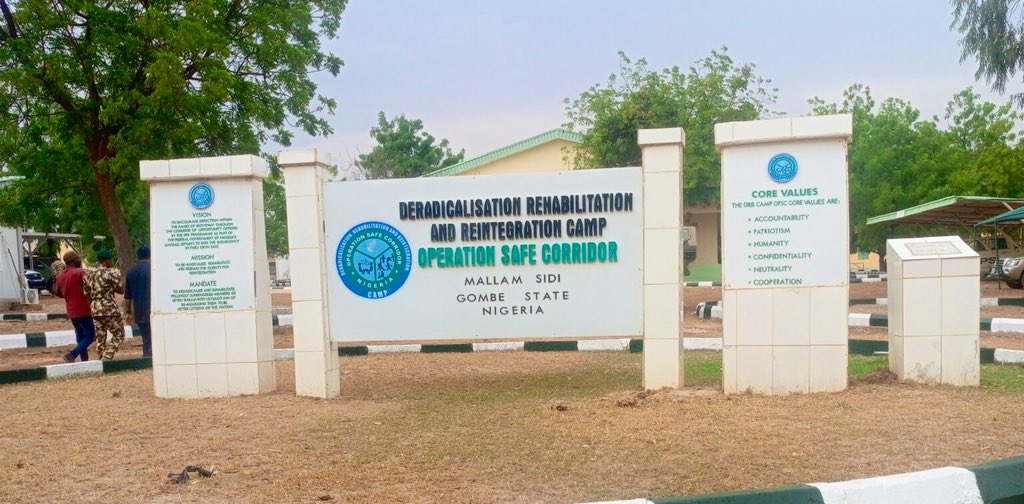
Nigeria’s fight against violent extremism is mostly known for military action. But when I visited Deradicarisation, Rehabilitation and Reintegration (DRR) Camp, Operation SAFE CORRIDOR, Mallam Sidi in Gombe State, I saw another side of the story, one that is quiet but very important and impactful.
This programme, an initiative of the Federal Government of Nigeria, started in 2015, is not just about rehabilitation or reintegration. From what I personally saw, the main focus of the programme is deradicalisation. This process is designed to help people change their mindset, correct wrong beliefs, and prepare them to live normal lives again.
When I got to the camp and interacted with the de-radicalised persons, one thing was crystal clear to me. I quickly realised that this is not just an ordinary support programme. It is a serious, organised, well-intentioned and deliberate process with a clear objective. The people there are taken through different stages that help them think differently and see life in a better way.
Many of them spoke openly. Some told me how they ended up in difficult situations, not all of them by choice. Through our discussions, I could see that this programme is giving them a second chance to rebuild their lives.
Nigeria has now realised that military force alone cannot end the insurgency. From what I observed, the problem is not just about weapons, but about wrong beliefs, fear, and manipulation. That is why this programme focuses on changing the mindset.
The programme is also supported by international partners like the UK, the EU, the International Organisation for Migration, the International Committee of the Red Cross, and UNICEF. They provide training, technical support, and other assistance.
I also learned that neighbouring countries in the Lake Chad region, like Niger, Chad, and Cameroon, are involved in the programme. This explains why foreign nationals from different African countries are part of it, including one each from Burkina Faso and Cameroon, two from Chad, and four from the Niger Republic.
During my visit, I learnt that the programme runs for about 24 weeks. More than 17 government agencies are involved, including the Ministry of Justice, Ministry of Education, Ministry of Interior, Ministry of Health, National Emergency Management Agency, Department of State Services, National Drug Law Enforcement Agency, and the Nigerian Correctional Service.
What stood out for me most was the focus on changing thinking.
There are religious sessions handled by trusted scholars, counselling for trauma, and classes that teach responsibility and how to live peacefully in society. The participants are also exposed to skills acquisition programmes, including carpentry, welding, livestock, and fish farming, among others, to help them become self-reliant after completing the programme.
I also want to correct a common misunderstanding. From what I was clearly told during my visit, people who committed serious crimes or held top positions in violent groups are not part of this programme. Those individuals face prosecution by the relevant authorities. The programme focuses on people who were caught in the violent grip of insurgency, whose cases are minor, forced, or based on circumstances of manipulation.
One thing I did not like before coming was how people described the participants as withdrawn or difficult. But what I saw was different. It was the direct opposite.
During my interactions with them, many were open, willing to talk, and ready to learn new things. Some even shared their experiences confidently and showed interest in building a better future.
Officials at the camp also explained that they look out for changes such as better behaviour, calmness, willingness to relate with others, and openness to new ideas.
I also saw a newly built deradicalisation studio donated by the IOM, where discussions, media, and guided sessions are used to engage participants. This shows that the programme is improving and becoming more advanced.
Since it started over 10 years ago, more than 3,300 people have gone through the programme, with over 744 deradicalised persons this year.
The distribution of deradicalised participants who graduated from different states across the country challenges the claim that the programme is training those who killed Nigerians.
A breakdown of the graduates shows that the majority are from the North-East, with 597 from Borno State and 58 from Yobe State. Others come from several states, including 10 from Adamawa, 12 from Bauchi, 15 from Kano, three from Ebonyi, and one each from Enugu and Akwa Ibom. There are also five from Kogi, two each from Plateau, Sokoto, and Niger, as well as four from Nasarawa State.
This shows that the government believes in what it is doing.
From the people I spoke with, the biggest change comes from within. One of them, Basil Anetochukwu, told me he came in scared and confused after being detained. But over time, counselling and training helped him change how he sees himself. He said he now believes he can live a normal life again.
Another deradicarised person, Usman Hassan, is now running a small provision shop after leaving the programme. He said the skills and mental transformation he gained from the camp helped him start something for himself.
Also, Jimoh Sifian told me he did not just learn a trade, but now understands life better and how to make good decisions.
From what I saw, deradicalisation is very important.
Many people involved in insurgency are not always fully committed. Some were forced, misled, or simply found themselves in the wrong place. Without a programme like this, some may still hold wrong beliefs, communities may continue to reject them, and there is a risk of them returning to violence. This is why deradicalisation is not optional, but necessary.
The programme is working, but it depends on what happens after participants leave. If communities accept them and the government continues to support them, the results will last. If not, the progress can be lost.
The military also made it clear that this programme is not about mercy. It is part of a broader strategy to support what is being done on the battlefield. From my visit, I saw that the real work is not just inside the camp, but after participants leave. Acceptance, monitoring, and support are very important.
For me, visiting the camp opened my eyes.
This programme is not just about policy or numbers. It is about people, their stories, and their second chance. If this programme did not exist, many of these individuals might still be in detention, rejected by society, or at risk again.
During my visit, I also became aware of a video circulated by a Danish blogger, Jones Raw, claiming that participants in the programme are armed, mobilised, or deployed for combat operations. What I saw at the camp clearly contradicts this claim.
This is why the Coordinator Operation SAFE CORRIDOR, Brigadier General Yusuf Ali, clarified in a statement that the programme “remains a strictly non-kinetic, multi-agency programme designed to facilitate the deradicalisation, rehabilitation, and reintegration of carefully screened and profiled individuals.” He stressed that “at no point are participants armed, mobilised, or deployed for combat operations.”
He also made it clear that the camp is open to anyone who wants to carry out an independent investigation and study what happens there.
The big question for Nigeria now is simple: can we achieve lasting peace without programmes like this? From what I saw with my own eyes, the answer is no. Because this fight is not only about guns, it is also about changing the mind.
The writer, Victor Akaa, who visited the camp, has first-hand information and writes from Abuja.